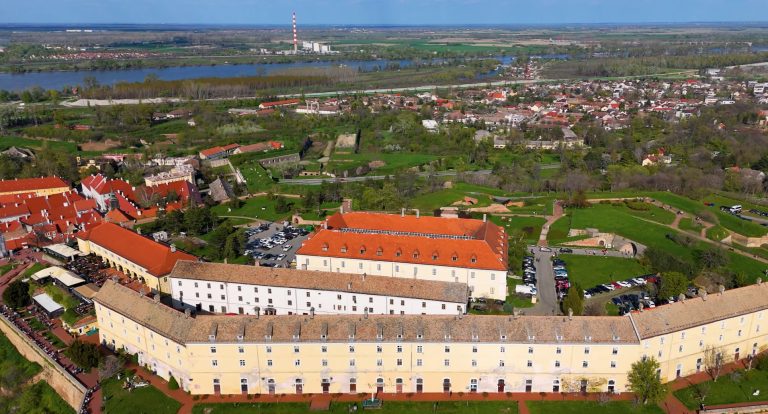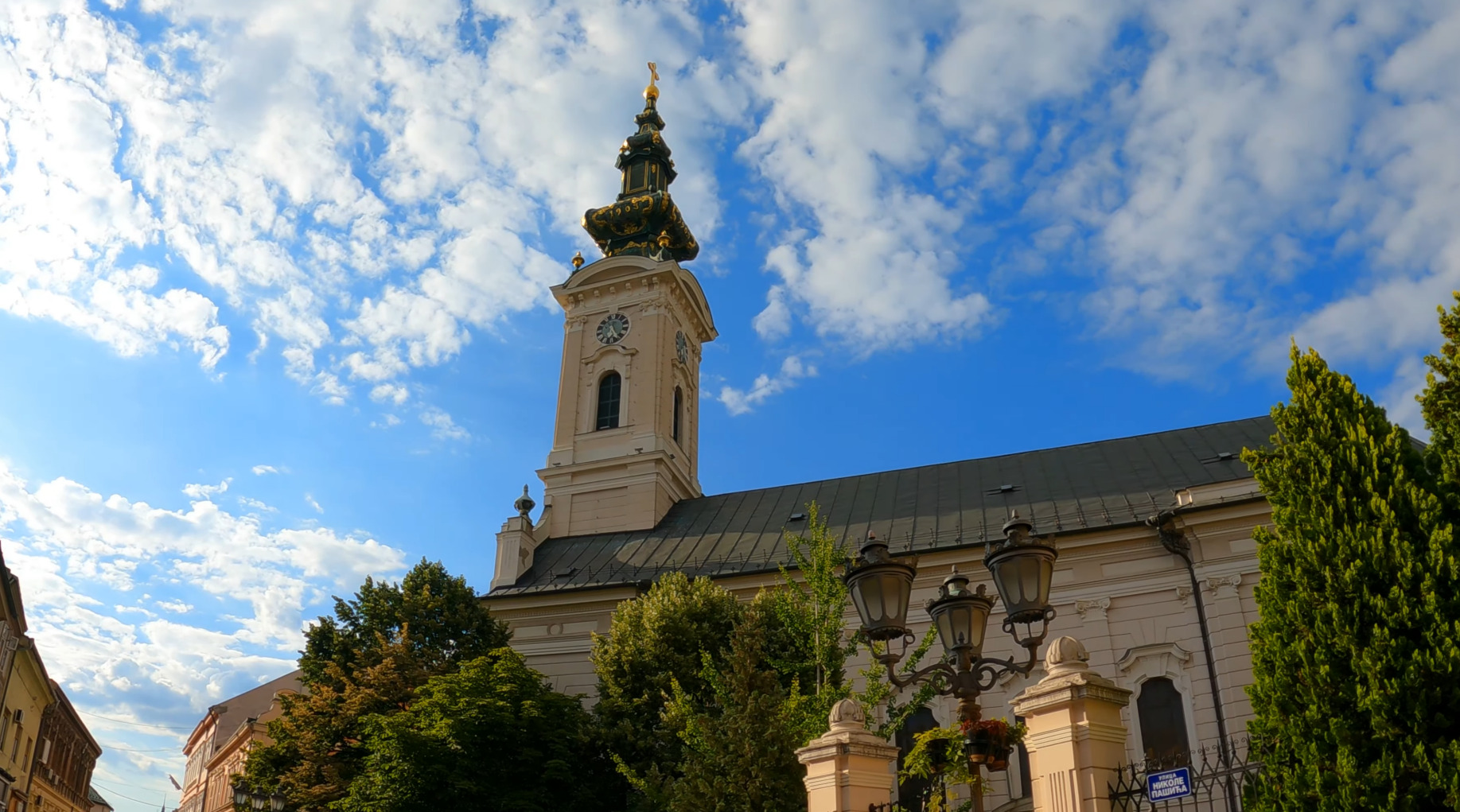
Novi Sad vs Belgrade: Which One Fits Your Trip Better?
It looks simple at first.
Belgrade is bigger, louder, more famous. Novi Sad is smaller and easier to fit into a short trip.
Then you actually spend a day in both — and the logic breaks.
One keeps pulling you in different directions. The other just… unfolds in front of you.
And suddenly it’s not about size anymore.
Quick realityMost travelers don’t actually choose between these cities. They end up combining them — usually staying in Belgrade and visiting Novi Sad as a short trip.
The real question is not “which one is better,” but how each one fits into your trip.
Quick Comparison: Novi Sad vs Belgrade
| Factor | Belgrade | Novi Sad |
|---|---|---|
| Size | Large capital city | Compact regional city |
| Vibe | Energetic, chaotic, intense | Calm, structured, relaxed |
| Walkability | Limited (area-based) | High (city-wide) |
| Nightlife | Major European nightlife hub | Casual bars, seasonal events |
| Time Needed | 2–4 days | 1–2 days |
| Cost | Slightly higher | Slightly lower |
| Travel Style | Urban exploration | Walkable experience |
The Core Difference: How These Cities Actually Work
People usually reduce this to size. That’s not the point. Bigger vs smaller. More things to do vs fewer.
That’s not where the real distinction is.
The real difference is structural — how the city behaves when you spend a full day inside it.
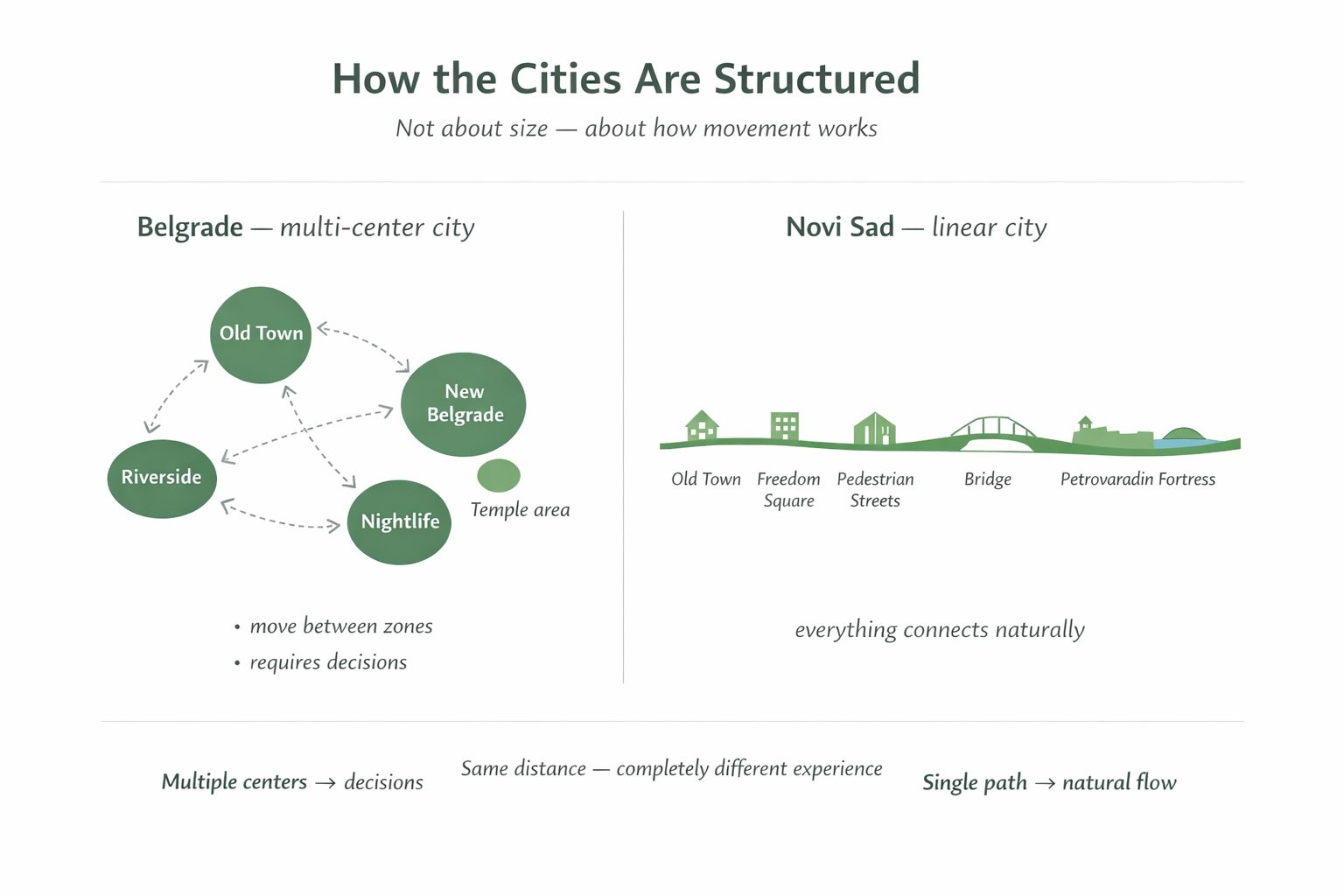
Belgrade vs Novi Sad — Structural Logic
Belgrade → multiple centers → constant movement between zones
Novi Sad → single core → natural walking flow → connected experience
Belgrade doesn’t present itself as a single, clear experience.
You move between areas — the old town, the fortress, riverside zones, nightlife districts, New Belgrade. Each part feels like its own pocket, and the city only starts making sense after you’ve pieced those parts together.
This creates a certain energy. There’s always something happening somewhere else. But it also means your day is rarely linear.
You don’t just walk through Belgrade. You navigate it.
What this means in practiceA typical day involves multiple transitions — walking, taxis, or public transport between areas that don’t naturally connect into a single route.
Novi Sad: A City You Move Through
Novi Sad works in a completely different way.
You don’t need to figure it out. The structure is already there.
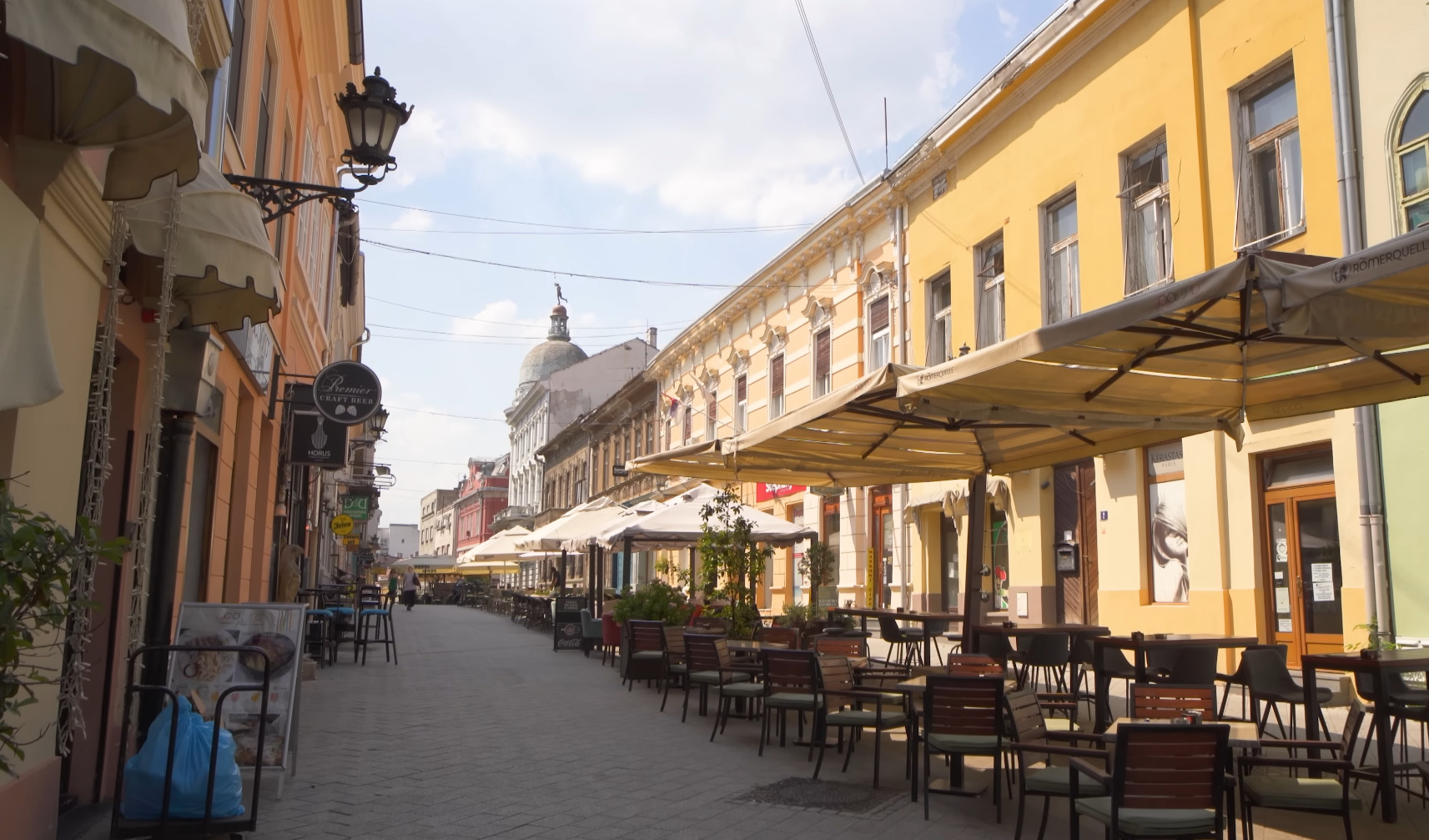
You start in the center, drift through pedestrian streets, cross the bridge, reach the fortress, and eventually end up by the river. It unfolds in a way that feels almost accidental — but it’s not.
The entire city behaves like a single, connected path.
Typical Novi Sad Flow
Old Town → Freedom Square → pedestrian streets → bridge → Petrovaradin Fortress → Danube riverside
That’s why Novi Sad often feels easier. Not because there’s less to do, but because everything aligns into a clear movement.
How You Experience a Day in Each City
This is where it starts to feel different.
Not in theory — but in how your day actually plays out.
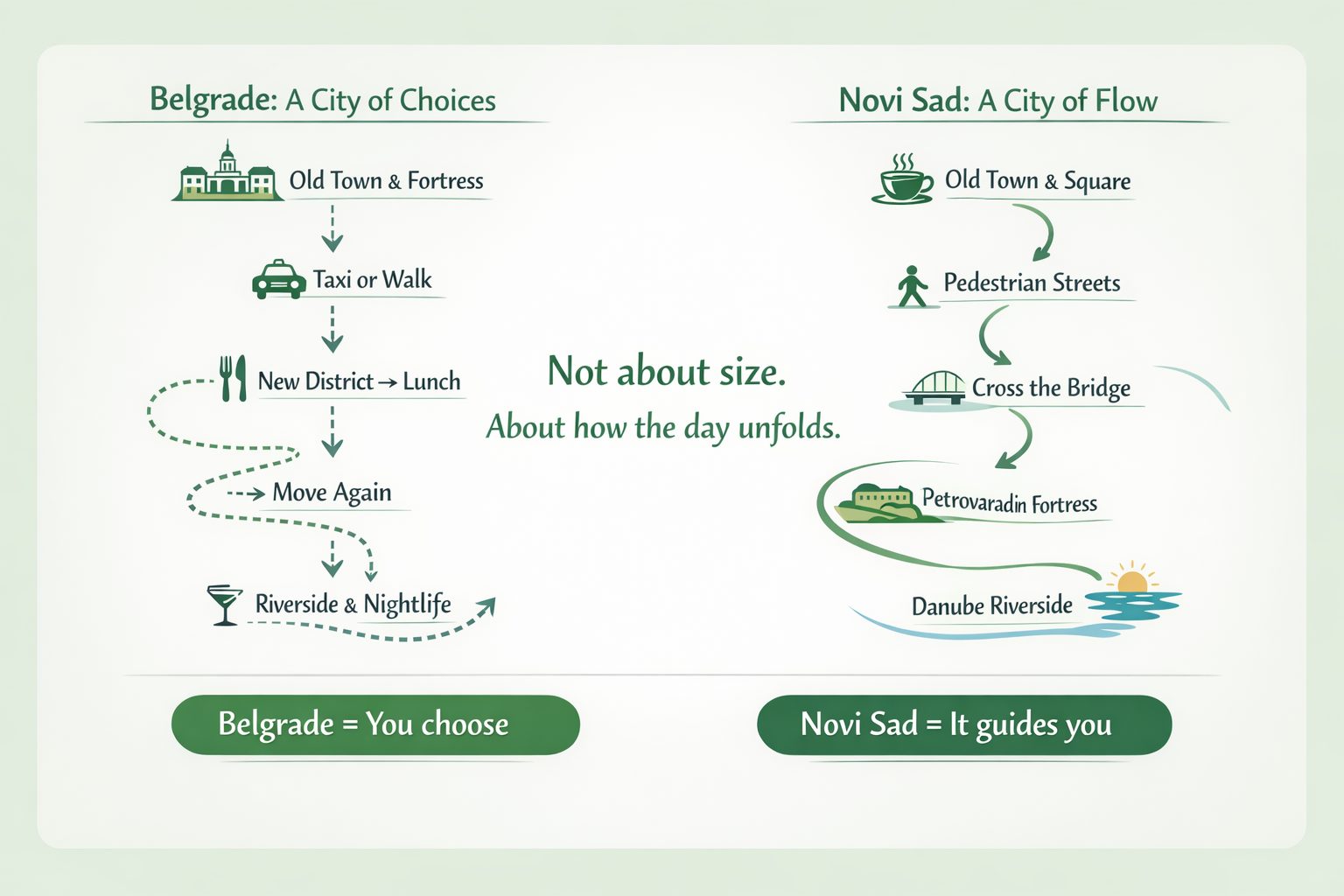
A Day in Belgrade
- Start in the old town area and explore Kalemegdan Fortress
- Move toward a different district for lunch (often requiring transport)
- Shift again toward riverside or another neighborhood
- Rest, then head out again for nightlife — usually in a completely different area
There’s variety. And friction. Each part of the day requires a decision — where to go next, how to get there, what’s worth the effort.
For some travelers, that’s exactly the appeal.
A Day in Novi Sad
- Start in the Old Town with coffee on a central square
- Walk through pedestrian streets without needing a plan
- Cross the bridge toward Petrovaradin Fortress
- End the day by the Danube, with everything already connected
No major decisions. No jumps between zones. The day builds naturally without forcing it.
And that’s the key difference most comparisons miss.
Atmosphere: How Each City Feels
You notice the difference almost immediately — not in landmarks, but in how the city reacts to you.
One feels like it’s already in motion before you arrive. The other waits for you to settle into it.
Belgrade: Energy First, Structure Later
Belgrade doesn’t ease you in.
Traffic, noise, layers of architecture that don’t quite match, people moving fast — it feels active from the first hour. Not polished, not curated. Just… alive in a slightly chaotic way.
There’s no single mood. It shifts depending on where you are. One street feels historic, the next feels completely modern, and a few blocks later you’re in something that looks unfinished but still somehow works.
That unpredictability is part of the appeal.
Important to understandBelgrade is not a “pretty” city in the traditional sense. It’s not built around visual harmony — it’s built around movement, contrast, and intensity.
If you like cities that feel raw and constantly changing, Belgrade delivers that almost effortlessly.
Novi Sad: Calm, Balanced, Readable
Novi Sad works in the opposite way.
The streets are cleaner, the center is more organized, and everything feels easier to read. You don’t need time to “figure it out” — the structure is immediately visible.
There’s less noise, less pressure, fewer sharp transitions between areas.
Instead of intensity, you get consistency.
What stands outNovi Sad feels closer to Central European cities than to the rest of the Balkans. The rhythm is slower, the streets are more cohesive, and the experience is easier to follow.
For some people, that feels refreshing. For others, it can feel slightly too quiet — especially if you’re expecting constant activity.
Nightlife: Where the Difference Becomes Obvious
If nightlife matters at all, the choice becomes much clearer.
Belgrade: One of Europe’s Strongest Nightlife Scenes
Belgrade has built a reputation around its nightlife — and it’s not exaggerated.
Clubs on the rivers, late start times, long nights, a mix of locals and international visitors. The city doesn’t wind down early. It builds up toward the night.
What defines nightlife in Belgrade
- Late start (often after 23:00)
- Floating river clubs (splavovi)
- Wide mix: electronic, local, mainstream
- Multiple nightlife zones, not one central area
This is not casual nightlife. It’s a core part of the city’s identity.
If your trip includes going out — even once or twice — Belgrade naturally supports that.
Novi Sad: Social, But Not Night-Driven
Novi Sad has bars, cafés, and some nightlife — but it works differently.
Evenings are more about sitting, talking, and staying out casually rather than moving between clubs or planning a full night out.
There are exceptions, especially during events like EXIT Festival, when the city shifts completely. But outside of that, nightlife is not the main driver.
Reality checkIf nightlife is one of your priorities, Novi Sad will feel limited. It’s not designed around night energy in the same way Belgrade is.
That doesn’t make it worse — just different.
Things to Do — But Framed the Right Way
Most comparisons list attractions.
That approach misses the point.
The difference isn’t how many things there are — it’s how those things connect.
Belgrade: Scattered Highlights
Belgrade has more to see, no question.
Main points of interest
- Kalemegdan Fortress
- Stari Grad (Old Town)
- Skadarlija street
- Temple of Saint Sava
- New Belgrade districts
- Riverside zones and floating clubs
But these places don’t naturally connect into a single route.
You move between them — often with effort. That’s why the city feels bigger than it actually is.
What to expectEven a simple sightseeing day in Belgrade usually involves planning where to go next and how to get there.
Novi Sad: A Connected Experience
Novi Sad has fewer “headline” attractions, but they form a complete experience when combined.
Main points of interest
- Old Town and Freedom Square
- Pedestrian streets (Zmaj Jovina, Dunavska)
- Danube riverfront
- Petrovaradin Fortress

The key difference is how these places relate to each other.
You don’t choose between them — you pass through them.
How attractions connect in Novi Sad
Center → streets → bridge → fortress → river → back to center
This is why the city often feels “complete” even in a short visit.
Everything connects. You feel it almost immediately.
Cost: Is Novi Sad Cheaper Than Belgrade?
Yes, Novi Sad is cheaper. But not in the way people expect.
| Category | Belgrade | Novi Sad |
|---|---|---|
| Accommodation | Moderate to higher (capital pricing) | Lower, more consistent |
| Restaurants | Wide range, slightly higher average | Generally cheaper |
| Coffee / cafés | Similar pricing | Similar pricing |
| Transport | More frequent use needed | Rarely needed |
| Activities / tours | More variety, higher ceiling | Fewer options, lower cost |
Where Novi Sad becomes noticeably cheaper is not individual prices — it’s how you spend.
You walk more, move less, and naturally avoid transport costs and time loss. The city structure itself reduces spending without you trying to optimize anything.
Key differenceBelgrade can become more expensive simply because you move more between areas — taxis, time, and spontaneous decisions add up.
Still, both cities remain affordable compared to most of Europe. This is not a high-stakes budget decision.
How Much Time Do You Actually Need?
This is where most people make the wrong call.
They assume both cities deserve the same amount of time — or they underestimate how quickly Novi Sad unfolds.
Realistic time expectations
- Belgrade: minimum 2 days, ideally 3–4
- Novi Sad: half-day possible, 1 full day comfortable, 2 days relaxed
Belgrade: Needs Time to Make Sense
Belgrade doesn’t reveal itself immediately.
The first day often feels scattered — you see places, but they don’t fully connect yet. It’s only after moving between areas a few times that the structure begins to emerge.
That’s why short visits can feel incomplete.
You need time not just to see the city, but to understand how it works.
Novi Sad: Works Almost Immediately
Novi Sad is the opposite.
Within a few hours, you already understand the layout. By the end of the day, you’ve experienced most of what defines the city.
That doesn’t make it shallow — just efficient.
Important nuanceSpending more time in Novi Sad doesn’t necessarily add new layers — it slows the experience down rather than expanding it.
Who Should Choose Novi Sad vs Belgrade?
This is where the comparison finally becomes useful.
Not in theory — but in matching the city to your travel style.
Choose Belgrade if you want:
- A larger, more dynamic city experience
- Strong nightlife and late evenings
- Multiple districts to explore over several days
- An urban atmosphere with contrast and unpredictability
Belgrade works best if you enjoy movement, variation, and a bit of friction between places.
It rewards curiosity and energy more than efficiency.
Choose Novi Sad if you want:
- A compact, walkable city
- A clear and relaxed daily flow
- A slower pace without losing structure
- A destination that “just works” without planning
Novi Sad is less about discovery and more about ease.
It removes complexity instead of adding options.
When the Choice Becomes Obvious
Simple decision logic
- If you have 1 day → Novi Sad makes more sense
- If you have 3+ days → Belgrade becomes essential
- If you care about nightlife → Belgrade wins clearly
- If you prefer walking over planning → Novi Sad fits better
Most travelers don’t choose one or the other in isolation.
They combine both — often without realizing that this is actually the best approach.
Can You Visit Novi Sad and Belgrade in One Trip?
Not only can you — you probably should.
The two cities are close enough that treating them as separate trips doesn’t really make sense unless you’re very short on time.
Distance and travel time
- Distance: ~100 km
- Train: ~30–40 minutes (fast and reliable)
- Car: ~1-2 hour
- Bus: ~1–1.5 hours
This changes the decision completely.
Instead of choosing one city, you’re deciding how to combine them.
Best Way to Combine Novi Sad and Belgrade
There are a few common ways to structure a trip. The right one depends mostly on how much time you have.
- Short trip (1–2 days)
Focus on Novi Sad. It delivers a complete experience quickly and doesn’t require logistics. - Standard trip (3 days)
Stay in Belgrade and visit Novi Sad as a day trip. This gives you both contrast and structure without changing accommodation. - Longer trip (4–5 days)
Split your stay: Belgrade first, then 1–2 nights in Novi Sad for a slower, more relaxed finish.
Typical Combined Route
Belgrade base → Novi Sad day trip → return to Belgrade
This is the most efficient setup for most travelers.
Belgrade gives you scale and variety. Novi Sad resets the pace and simplifies the experience.
Why this worksThe contrast between the two cities actually improves the trip. After Belgrade’s intensity, Novi Sad feels clearer and easier to process.
When Novi Sad Works Better as a Day Trip
In many cases, Novi Sad doesn’t need to be a standalone destination.
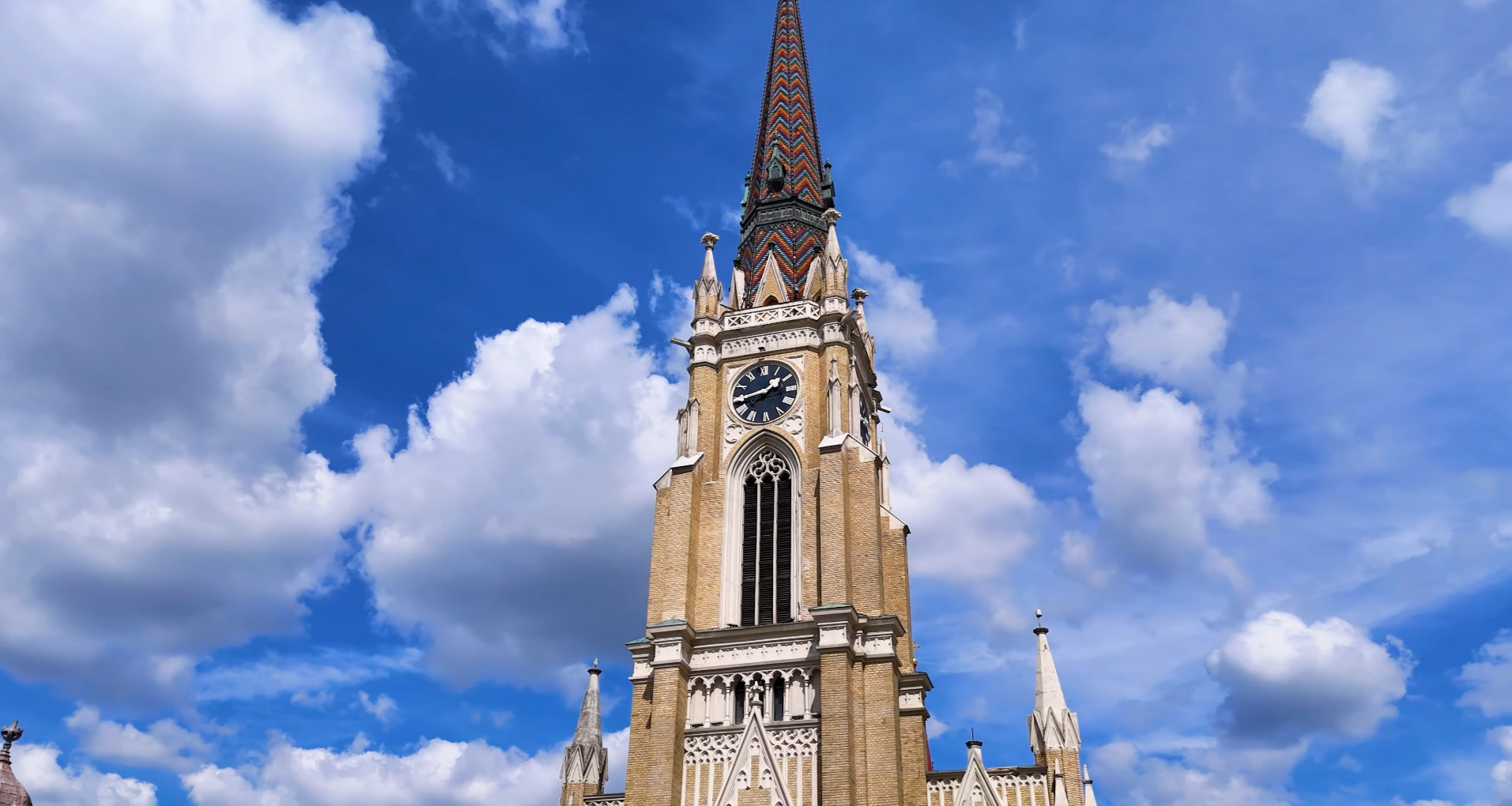
Its structure makes it ideal for a single, well-paced day — especially if you’re already based in Belgrade.
You can arrive in the morning, walk the full route through the city, reach the fortress, spend time by the river, and return in the evening without feeling rushed.
That’s difficult to replicate in larger cities.
Honest Drawbacks: What You Might Not Like
No comparison is complete without looking at where each city falls short.
Belgrade — Potential Downsides
- Can feel chaotic and unstructured at first
- Not visually “beautiful” in a traditional sense
- Requires more planning and movement between areas
- Noise and pace may feel overwhelming
Belgrade rewards effort — but it doesn’t simplify things for you.
Novi Sad — Potential Downsides
- Can feel too quiet or slow for some travelers
- Fewer attractions overall
- Experience can feel “complete” quickly
- Limited nightlife outside major events
Novi Sad is easy — but that simplicity can also limit how long it holds your attention.
Final Decision: Novi Sad or Belgrade?
If you’re trying to choose just one, the decision comes down to how you want your trip to feel.
Quick decision summary
- Choose Belgrade if you want energy, variety, and a city that evolves over several days
- Choose Novi Sad if you want clarity, walkability, and a complete experience in a short time
But in reality, most trips benefit from both.
Not because they’re similar — but because they’re not.
Belgrade gives you scale. Novi Sad gives you structure. Together, they create a more balanced experience than either one alone.
If you’re planning how to divide your time, it helps to think in terms of movement — not just destinations.
Start with the broader picture, then narrow it down into actual routes and days.
From there, the rest of the trip tends to fall into place naturally.
For a broader decision on whether Novi Sad fits into your trip at all, see the full breakdown in /is-it-worth-visiting.
If you’re already planning days and routes, the structure in /itinerary helps turn that decision into something practical.
And if you’re considering the most efficient way to connect both cities in a single day, the full route is explained in /belgrade-to-novi-sad-day-trip.